
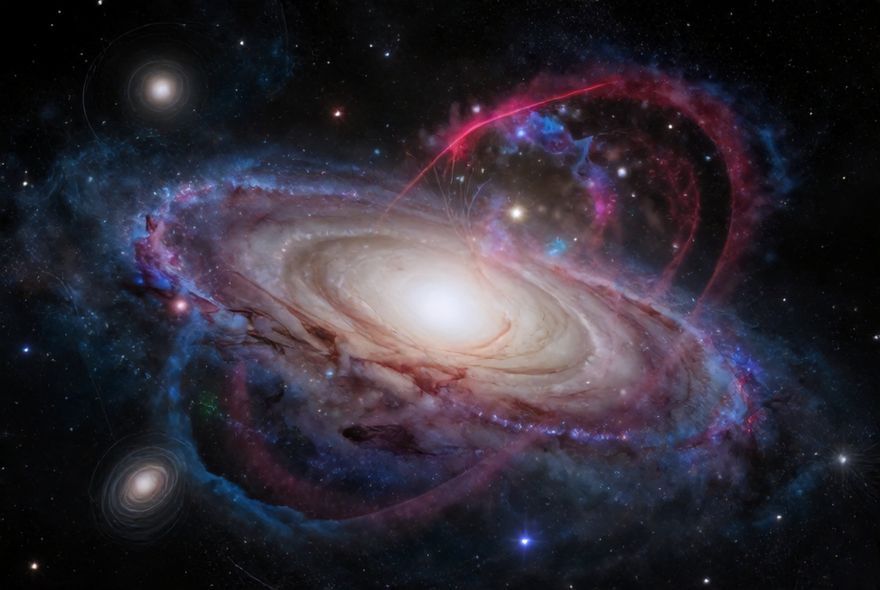
Ever wondered if there’s another ‘you’ sipping coffee, pondering life’s great mysteries, or just wondering where your left sock went? Welcome to the fascinating rabbit hole of Why Quantum Mechanics Suggests Infinite Parallel Universes Coexist. In this blog post, we’ll dive headfirst into the mind-bending realms of quantum superposition and the many-worlds interpretation. It’s a universe-hopping adventure where we explore infinite parallel realities—because why settle for just one universe when you can have them all? Buckle up; it’s going to be a mind-blowing ride!
Key Takeaways
- Dive into the wild world of quantum superposition – where particles do the multiverse limbo dance.
- Ever thought there were infinite versions of you out there? It’s all thanks to quantum mechanics!
- The many-worlds interpretation isn’t just sci-fi fantasia—it’s a legit theory quantum physicists are pondering.
- Quantum superposition might sound like a fancy coffee order, but it’s shaking up our universe (literally).
- Feel like you’re living in another reality some days? Quantum mechanics says you might not be far off!
- Parallel universes: not just for comic book heroes thanks to the mind-bending possibilities of quantum physics.
Understanding Quantum Superposition and Reality
You know that moment when you’re standing at a crossroads, wondering which path to take, and you can’t help but imagine both futures simultaneously? Well, quantum mechanics says particles actually do this—literally existing in multiple states at once. It’s called quantum superposition, and it’s the foundation of why physicists believe infinite parallel universes might coexist. When we dive into the quantum realm, the rules of everyday reality completely flip on their head. Particles don’t have definite properties until we observe them, which sounds wild, but it’s been proven countless times in labs worldwide. This strange behavior hints at something even more profound: maybe when particles exist in multiple states, they’re not just theoretically doing so—they’re actually inhabiting different realities simultaneously.
- Superposition Basics: Unlike classical objects that are either here or there, quantum particles exist in a blend of all possible states until measurement collapses them into one reality. Think of it like a coin spinning in the air—heads and tails both exist until it lands.
- The Measurement Problem: The act of observing a quantum system fundamentally changes its behavior, a phenomenon that suggests consciousness or observation might play a role in determining which reality manifests. This mystery has puzzled physicists for nearly a century.
- Real-World Applications: Quantum superposition isn’t just theoretical mumbo-jumbo. It’s the backbone of quantum computers, which process information exponentially faster than classical machines by exploiting superposition states.
- Schrödinger’s Cat Analogy: The famous thought experiment illustrates superposition perfectly—a cat in a sealed box is simultaneously alive and dead until observed. While the cat itself isn’t literally in both states, the quantum particles governing the system are, which is the real mind-bender.
The Many-Worlds Interpretation Explained
Here’s where things get absolutely mind-blowing. The many-worlds interpretation, proposed by Hugh Everett in 1957, suggests that every quantum event spawns a branching of reality. Instead of superposition collapsing into one outcome when observed, both (or all) outcomes actually happen—just in separate, coexisting universes. Imagine standing at that crossroads again, but this time, you don’t choose. Instead, the universe splits: one version of you takes the left path, another takes the right, and both are equally real. This interpretation transforms quantum mechanics from a probabilistic guessing game into a definitive statement about the structure of reality itself. The many-worlds interpretation suggests that infinite parallel universes aren’t science fiction—they’re a logical consequence of how quantum mechanics actually works.
- The Branching Universe Model: Every time a quantum event has multiple possible outcomes, reality branches into separate timelines where each outcome occurs. You’re not living in one branch; you’re experiencing one subjective thread through the branching structure of existence.
- No Wave Function Collapse: Unlike other interpretations that claim superposition “collapses” into one state, many-worlds says the wave function never collapses. All possibilities remain equally real, just in different universes. This elegantly solves the measurement problem without invoking mysterious wave collapse mechanisms.
- Determinism Without Randomness: Interestingly, many-worlds is completely deterministic. Nothing is truly random; it just appears that way because we can only experience one branch. From a god’s-eye view, everything that can happen does happen—deterministically.
- Growing Support Among Physicists: While once controversial, surveys show that many-worlds interpretation gains more acceptance among quantum physicists each year. It’s intellectually satisfying and avoids some philosophical pitfalls of other interpretations.
- Infinite Branches, Infinite Realities: If every quantum event branches reality, and quantum events happen trillions of times per second throughout the universe, then we’re talking about an incomprehensibly vast multiverse where every possible outcome of every possible event actually exists somewhere.
How Quantum Entanglement Connects Parallel Universes
Now let’s talk about quantum entanglement—Einstein called it “spooky action at a distance,” and honestly, he wasn’t wrong. When two particles become entangled, measuring one instantly affects the other, regardless of the distance separating them. But here’s the kicker: if we adopt the many-worlds interpretation, entanglement reveals something stunning about how parallel universes might be connected. When particles are entangled, they’re not just mysteriously linked across space—they might be linked across different branches of reality. This suggests that parallel universes aren’t completely isolated islands; they’re woven together through quantum correlations. It’s like discovering that parallel dimensions are actually part of one vast, interconnected fabric.
- Entanglement as Reality Bridge: Entangled particles maintain perfect correlation across all branches of the multiverse. When one particle branches into multiple states, its entangled partner does too, maintaining their connection across all parallel universes simultaneously.
- Locality Violation: Quantum entanglement violates classical locality—the principle that objects are only influenced by their immediate surroundings. This violation becomes even more profound when considering many-worlds, suggesting that reality operates on principles far stranger than we intuitively understand.
- Bell’s Theorem and Beyond: John Bell’s experiments proved that entanglement is real and can’t be explained by hidden variables. In a many-worlds framework, this means the correlations between parallel universes are fundamental to the universe’s architecture.
- Quantum Teleportation Implications: Scientists can teleport quantum information using entanglement, which works because the information exists across multiple parallel states simultaneously. This technology hints at the deep interconnectedness of the multiverse.
The Double-Slit Experiment and Parallel Reality Evidence
Remember when we talked about superposition? The double-slit experiment is the poster child for demonstrating it. Shoot electrons at two slits, and they act like waves, passing through both simultaneously and interfering with themselves. But watch which slit they go through, and suddenly they act like particles, going through one slit or the other. The weirdness here is profound: the act of observation literally changes the behavior of electrons. In the context of parallel universes, the double-slit experiment becomes even more fascinating. According to many-worlds interpretation, the electron doesn’t choose which slit to go through—it goes through both. In one branch of reality, it goes left; in another, it goes right. When we observe it, we’re not collapsing a single electron into one path; we’re simply discovering which branch we’re in. This experiment provides compelling evidence that parallel realities are operating simultaneously, and our observation merely determines which one we perceive.
- Wave-Particle Duality Resolved: The double-slit experiment shows particles behaving as both waves and particles, which seems contradictory. Many-worlds resolves this: particles genuinely behave as waves (going through both slits) until observation forces us into a specific branch where they’ve gone through one slit or the other.
- Observation and Reality: The experiment proves that observation isn’t passive—it actively influences quantum systems. This suggests that reality itself branches based on what we measure, making consciousness or measurement fundamental to the structure of existence.
- Interference Patterns Across Branches: The interference patterns observed in the double-slit experiment suggest that particles in different branches of reality are somehow interfering with each other. This quantum interference is evidence of cross-branch interactions within the multiverse.
- Reproducibility and Consistency: Scientists can repeat the double-slit experiment thousands of times with identical results, proving it’s not a fluke. This consistency across trials strengthens the case that we’re observing fundamental properties of reality, not experimental artifacts.
Quantum Decoherence and the Birth of New Universes
Here’s something that’ll keep you up at night: quantum decoherence is the process where quantum systems lose their superposition properties and become “classical.” When a particle interacts with its environment, superposition collapses, and we observe definite outcomes. But what if decoherence isn’t really collapse? What if it’s the moment when a new parallel universe is born? In the many-worlds framework, decoherence marks the branching point where one quantum system splits into multiple versions, each representing a different outcome. Every time decoherence happens—which is constantly, billions of times per second—new universes are created. The universe is literally multiplying itself, spawning infinite parallel realities as quantum events unfold. It’s staggering to consider, but this process might explain why we observe a universe fine-tuned for life. With infinite parallel universes existing, at least one is bound to have the right conditions for consciousness to emerge.
- Constant Universe Creation: Decoherence happens at quantum scales billions of times per second. Each decoherence event creates new branches, meaning the multiverse is continuously expanding with fresh parallel universes emerging from every quantum event.
- Environmental Interaction Triggers Branching: Particles don’t decohere in isolation—interaction with the environment causes it. This means the universe is fundamentally interconnected, with quantum events in one location triggering branching across vast distances through environmental coupling.
- Irreversibility and Time’s Arrow: Decoherence is essentially irreversible, which might explain why we experience time flowing in one direction. Once universes branch, they can’t merge back together, creating a one-way street through quantum history.
- Measurement as Environment Interaction: When we measure a quantum system, we’re interacting with it environmentally, triggering decoherence. This is why observation affects quantum systems—we’re literally causing the branching of reality through our measurements.
- The Thermodynamic Cost of Branching: Creating new universes through decoherence requires energy. The universe pays a thermodynamic price for spawning parallel realities, which might be reflected in entropy and the arrow of time itself.
Quantum Mechanics and the Fine-Tuning Problem
You’ve probably heard that our universe is remarkably fine-tuned for life. The fundamental constants—like the strength of gravity or the charge of an electron—seem almost impossibly calibrated to allow stars, planets, and conscious beings to exist. Change any of these constants by even a tiny percentage, and the universe becomes sterile. Scientists have puzzled over this for decades: is it just incredible luck, divine design, or something else? Enter infinite parallel universes. If the many-worlds interpretation is correct, then every possible set of physical constants exists somewhere in the multiverse. In some universes, gravity is stronger; in others, weaker. In some, the fine-structure constant is different; in others, identical to ours. Given infinite parallel universes with varying properties, it becomes statistically inevitable that at least some universes—including ours—would have the right conditions for life. We don’t need to invoke miracle or divine intervention; we just need to accept that we inhabit one of the life-friendly branches among infinite alternatives.
- The Anthropic Principle: The anthropic principle suggests that we observe our universe to be fine-tuned for life simply because we couldn’t observe any other kind. In a multiverse with infinite variations, observers can only arise in the rare universes where constants permit complexity.
- Avoiding Improbability: Rather than invoking astronomically unlikely coincidences, the multiverse explanation is actually more parsimonious. It’s easier to accept that infinite universes exist than to argue that one universe achieved perfect fine-tuning by chance.
- Testable Predictions: The multiverse hypothesis makes testable predictions about the distribution of constants across parallel universes. Some predictions have already been validated by observations of cosmic microwave background radiation.
- Varying Physical Laws: Different branches of the multiverse might not just have different constant values—they might operate under entirely different physical laws. Some might have extra dimensions, different particle types, or alternative force configurations.
- Why We’re Here: Quantum mechanics explains not just that we exist, but why we exist in a universe suited for consciousness. We’re in this branch because this is the only kind of branch where “we” can possibly emerge to ask the question.
Multiverse Implications for Science and Philosophy
So if infinite parallel universes really do coexist, what does that mean for science, philosophy, and our understanding of reality? Well, it fundamentally reshapes everything. Scientifically, it means we need to accept that much of reality might be unobservable to us—hidden away in parallel branches we can’t access. It challenges the scientific principle that theories must be testable and falsifiable. Philosophically, it raises mind-bending questions about identity, free will, and the nature of consciousness. If every choice spawns a universe where both outcomes occur, do you truly have free will? Are there infinite versions of you making different decisions right now? It’s delightfully paradoxical. The many-worlds interpretation also implies that nothing is ever truly lost. Every version of every possible event happens somewhere, making the multiverse a kind of cosmic repository of all possibilities. This has profound implications for how we understand causality, destiny, and the meaning of individual choices.
- The Problem of Testability: Critics argue that if parallel universes are truly unobservable, the many-worlds interpretation isn’t scientifically falsifiable. However, advocates point out that we can test predictions about our branch, which are mathematically equivalent to testing the multiverse hypothesis.
- Identity Across Branches: If you exist in multiple branches making different choices, which version is the “real” you? This philosophical puzzle challenges our intuitions about personal identity and raises questions about what makes you fundamentally you.
- Free Will and Determinism: Many-worlds resolves the classic free will paradox by being both deterministic and indeterminate. Everything that can happen does happen (determinism), but you can only experience one outcome (apparent indeterminacy).
- Information Conservation: The multiverse interpretation ensures that information is never truly destroyed. While information might disappear from our branch (like data falling into a black hole), it continues to exist in parallel universes, satisfying the principle of information conservation.
- Consciousness and Observer Effect: Many-worlds raises fascinating questions about consciousness. If observation triggers branching, does consciousness play a fundamental role in reality? Some interpretations suggest that conscious observers might be special in how they interact with quantum systems.
Current Research and Future Directions in Quantum Cosmology
While many-worlds interpretation remains theoretical, quantum physicists are actively exploring ways to test and refine our understanding of parallel universes. Recent research has focused on detecting signatures of the multiverse in observable phenomena, particularly in the cosmic microwave background radiation—the afterglow of the Big Bang. Scientists have looked for evidence of collisions between universes, which would leave distinctive patterns in this radiation. Some findings suggest tentative evidence for these collision signatures, though the jury is still out on whether this definitively proves parallel universes. Additionally, research into quantum computing is revealing new insights into how superposition and entanglement operate. As quantum computers become more powerful, they’ll probe deeper into quantum mechanics’ mysteries, potentially offering new evidence about the nature of parallel realities. The field is evolving rapidly, and what seems theoretical today might become confirmed science tomorrow.
- Cosmic Microwave Background Analysis: Researchers are scanning for unexpected patterns in the CMB that would indicate collisions between our universe and neighboring parallel universes. Cold spots and other anomalies are being analyzed for signs of universe-universe interactions.
- Quantum Computing Progress: As quantum computers process more qubits, they’re exploring superposition states more deeply. These machines are essentially probing the structure of parallel branches, offering indirect evidence about how quantum branching works.
- Gravitational Wave Detection: Advanced detectors like LIGO are opening new windows into quantum gravity. If parallel universes collide or interact gravitationally, gravitational wave patterns might reveal these interactions.
- Theoretical Refinements: Physicists are continuously refining the many-worlds interpretation, developing mathematical frameworks that address earlier criticisms. Recent work has clarified how probability emerges in a deterministic multiverse and how personal experience relates to branch structure.
- Interdisciplinary Exploration: The multiverse hypothesis now bridges physics, philosophy, mathematics, and even psychology. Researchers from diverse fields are contributing insights that enrich our understanding of what parallel universes might mean for human existence and consciousness.
Practical Implications and What It Means for Humanity
Okay, let’s bring this down to Earth for a moment. You might be wondering: “This is fascinating, but does it actually matter for my life?” The truth is, the practical implications are more profound than you might think. If infinite parallel universes truly coexist, it changes how we think about risk, decision-making, and responsibility. Every choice you make branches reality, creating versions of yourself experiencing different outcomes. This might sound like it diminishes personal responsibility—after all, if every choice happens somewhere, why does it matter which branch you end up in? But here’s the key: you only experience one branch. Your subjective reality is singular, even if the objective multiverse is infinite. This means your choices matter profoundly for your personal experience, even if every alternative also exists somewhere. Additionally, understanding quantum mechanics and the multiverse has practical applications in technology. Quantum computers, quantum cryptography, and quantum sensing all rely on the principles we’ve discussed. As these technologies develop, they’ll reshape industries, security, and how we process information. The quantum revolution isn’t coming—it’s already here.
- Decision-Making Under Uncertainty: Knowing that all outcomes exist might paradoxically help us make better decisions. Rather than agonizing over unknowable futures, we can focus on choosing outcomes that align with our values, knowing that other versions of us will experience alternatives.
- Quantum Technology Revolution: Quantum computers, already being developed by major tech companies, will solve problems classical computers can’t. They’ll revolutionize drug discovery, materials science, optimization, and artificial intelligence. The multiverse isn’t just theoretical—it’s the engine driving next-generation technology.
- Quantum Security: Quantum cryptography uses the principles of superposition and entanglement to create theoretically unbreakable encryption. As cybersecurity threats grow, quantum-secured communications will become essential infrastructure.
- Philosophical Comfort: For some, understanding the multiverse provides philosophical solace. Knowing that all possibilities exist somewhere can ease anxiety about missed opportunities or regretted choices. You didn’t fail to take that path—another version of you did take it, and that’s equally real.
- Future Scientific Understanding: As we develop better tools to probe quantum mechanics, our understanding of parallel universes will deepen. This might eventually lead to technologies or insights we can’t currently imagine, much like how electricity seemed magical before we understood it.
For a comprehensive exploration of how quantum mechanics supports the existence of infinite parallel universes, be sure to check out our detailed guide to quantum mechanics and parallel universe evidence today, which delves deeper into the scientific foundations and latest research in this mind-bending field.

We’ve taken a cosmic stroll through the mind-bending universe, or should we say multiverse, of quantum mechanics. At the heart of this strange science lies quantum superposition, a quantum quirk where particles exist in multiple states at once. This concept shatters the glass of our classical reality. Then there’s the many-worlds interpretation—Brace yourself! It proposes that every time a quantum event occurs, the universe splits, creating infinite parallel realities where every possibility plays out. Toss in some Schrödinger’s cats for good measure, and you’ve got a recipe for reality that’s richer than Aunt Edna’s holiday fruitcake. Although these concepts might sound like textbook sci-fi, they offer serious food for thought about the very nature of existence and reality.
Ready to tumble down the quantum rabbit hole? We just scratched the tip of the iceberg here. Embrace your inner science geek and dive into more out-of-this-world concepts by joining our community on Facebook, Instagram, and Twitter. Stay curious, keep questioning, and remember, in one universe or another, you’re a superhero at solving quantum puzzles!





Leave a Reply