
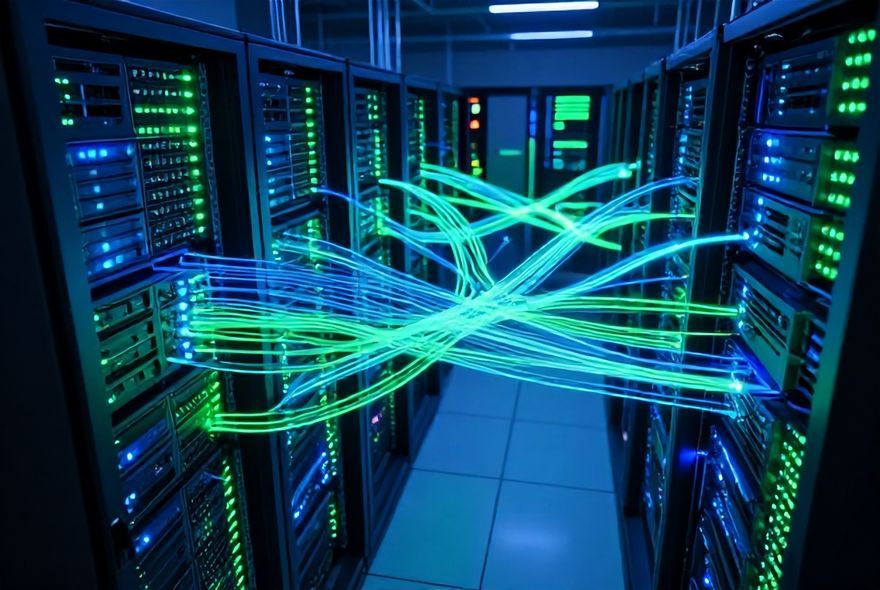
Ever wondered if your network could mend itself like Spider-Man’s web after a tough battle? In our latest deep dive, “Do You Know How AI Enables Self-Healing Networks,” we unravel the enchantment of networks that not only detect but also fix issues all by themselves! Imagine wiping out costly human errors and cutting the mean time to resolution drastically. Sounds like network magic, doesn’t it? We’ll explore how AI is reshaping infrastructure trends in fascinating ways, drawing insights from industry experts. Ready to geek out on the future? Let’s get started!
Key Takeaways
- Explore how AI transforms networks into self-healing marvels—goodbye human errors!
- Discover the magical world of AI-driven networks that auto-detect and fix issues.
- Find out how self-healing networks slash mean time to resolution—your IT team’s new best friend.
- Say goodbye to costly network downtime, thanks to AI’s preemptive problem-solving.
- Is AI the secret sauce to faultless network management? Dive in to find out!
- Learn about the latest AI infrastructure trends revolutionizing network maintenance.
What Are Self-Healing Networks and Why Should You Care?
So, you’ve probably heard the term “self-healing networks” thrown around in tech circles, right? It sounds like something out of a sci-fi movie—networks that magically fix themselves without human intervention. But here’s the thing: it’s very real, and it’s revolutionizing how we think about network management. Self-healing networks are essentially intelligent systems that use artificial intelligence to detect problems, diagnose issues, and implement fixes automatically. No waiting for a technician to notice something’s wrong. No midnight emergency calls. Just networks that work smarter, not harder. This isn’t just about convenience; it’s about fundamentally transforming AI infrastructure trends and keeping your systems running at peak performance 24/7.
- Autonomous Problem Detection: AI-powered networks continuously monitor system health and identify anomalies before they become critical issues, reducing downtime significantly.
- Real-Time Issue Resolution: When problems are detected, self-healing mechanisms automatically implement fixes, drastically reducing mean time to resolution and eliminating the need for manual intervention.
- Cost Reduction: By automating network repairs, organizations eliminate costly human errors and reduce operational expenses associated with dedicated network support teams.
- Predictive Maintenance: AI algorithms learn from historical data to predict potential failures before they occur, allowing networks to preemptively heal themselves.
- Scalability Without Headaches: As your infrastructure grows, self-healing networks scale intelligently without requiring proportional increases in IT staff or complexity.
The Intelligence Behind Automatic Network Repair
Let’s dive deeper into how this magic actually works. You know that feeling when something breaks and you have no idea what went wrong? AI eliminates that frustration by essentially giving your network a brain. Self-healing networks leverage machine learning models trained on massive datasets of network behavior patterns. These AI systems learn what “normal” looks like for your specific infrastructure, so when something deviates from that baseline, alarms go off—but here’s the cool part: the system doesn’t just alert someone; it springs into action. The AI analyzes the anomaly, determines the root cause, and executes predetermined solutions or adapts new ones based on what it’s learned. This represents a major shift in AI infrastructure trends, moving from reactive troubleshooting to proactive, autonomous management.
- Machine Learning Pattern Recognition: AI models identify subtle patterns in network traffic, latency, and resource utilization that humans would miss, enabling early detection of emerging issues.
- Root Cause Analysis at Scale: Instead of guessing what caused a network hiccup, AI algorithms trace back through logs and metrics to pinpoint the exact problem, whether it’s a misconfigured router or a DDoS attack.
- Automated Remediation Actions: Once a problem is identified, the system automatically executes fixes like rerouting traffic, scaling resources, or isolating compromised segments without human approval.
- Continuous Learning Loop: Every fix, every successful resolution, feeds back into the AI model, making it smarter and faster with each interaction—reducing mean time to resolution over time.
- Context-Aware Decision Making: Smart networks understand the business context of their fixes—they won’t perform maintenance during peak business hours if they can defer it to a quieter window.
How AI Detects Issues Before Humans Ever Notice
Here’s where things get genuinely fascinating. Traditional network monitoring is like having a security guard who checks the building once an hour. AI-enabled self-healing networks? That’s like having an eagle-eyed security system running every millisecond. We’re talking about continuous, real-time analysis of thousands of data points simultaneously. The AI doesn’t just watch for obvious failures like “the server is down.” It notices subtle shifts—a 2% increase in packet loss on a particular link, unusual latency spikes at specific times, or traffic patterns that deviate from historical norms. These early warning signs are often the canaries in the coal mine that precede major outages. By catching them early, self-healing networks prevent problems from cascading into full-blown disasters that would otherwise devastate your operations and require extensive human intervention to resolve.
- Anomaly Detection Algorithms: AI uses statistical models and neural networks to establish what’s “normal” for your network, then flags anything that deviates significantly—often hours or days before a human would notice.
- Behavioral Analytics: Instead of just monitoring traffic volume, AI analyzes behavioral patterns of applications, users, and devices to detect suspicious or abnormal activities that might indicate problems.
- Predictive Failure Analysis: Advanced AI models can literally predict when hardware will fail by analyzing performance degradation trends, allowing networks to self-heal by shifting workloads before failure occurs.
- Multi-Layer Monitoring: Self-healing networks monitor not just network traffic but also application performance, server health, database connections, and security metrics—nothing slips through the cracks.
- Intelligent Alerting: AI filters out noise and false positives, ensuring that alerts are meaningful and actionable, so you’re not drowning in notifications about non-issues.
Reducing Mean Time to Resolution: The Real Business Impact
Let’s talk about what actually matters to your bottom line. Mean time to resolution—MTTR for short—is the metric that keeps CIOs up at night. It’s the average time between when a problem occurs and when it’s fixed. Every minute of downtime costs money, reputation, and customer trust. Traditional network management? MTTR can be hours or even days when you factor in detection lag, diagnosis time, and the human coordination needed to implement fixes. Self-healing networks change that equation entirely. We’re talking about reducing MTTR from hours to minutes, sometimes even seconds. That’s not just an incremental improvement; that’s a fundamental transformation in how reliably your infrastructure operates. This dramatic reduction in resolution time is one of the most compelling reasons why self-healing networks are becoming a cornerstone of modern AI infrastructure trends.
- Instantaneous Detection and Response: Unlike humans who need time to notice problems, AI detects and begins responding within milliseconds, slashing the detection phase of MTTR from hours to near-zero.
- Elimination of Diagnostic Delays: While traditional troubleshooting requires manual investigation and hypothesis testing, AI already knows the root cause, jumping straight to solution implementation.
- Parallel Problem Solving: AI can simultaneously handle multiple issues across different parts of your network, whereas human teams tackle problems sequentially, creating bottlenecks.
- 24/7 Availability: Self-healing networks never sleep, work holidays, or take vacations—they’re always ready to respond, ensuring consistent MTTR regardless of time of day.
- Quantifiable ROI: Organizations implementing self-healing networks report MTTR reductions of 70-90%, translating directly to reduced downtime costs and improved service level agreements (SLAs).
Eliminating Human Error Through Intelligent Automation
You know what’s interesting? In many cases, the problems that plague networks aren’t actually caused by the network itself—they’re caused by us. A misplaced comma in a configuration file. A technician accidentally unplugging the wrong cable. A change made by someone who didn’t fully understand the downstream implications. These human errors are frustratingly common and often catastrophic. Self-healing networks tackle this problem at its root by removing humans from the equation during critical operations. The AI has been trained on best practices, understands the implications of every change, and executes fixes with mechanical precision. This doesn’t mean firing your IT team—it means elevating them from reactive firefighting to strategic planning and oversight. When the network heals itself, human errors in those emergency fixes simply can’t happen. This shift is transforming how organizations approach network management and is a key driver of AI infrastructure trends.
- Consistent, Repeatable Solutions: AI applies the same proven solution every time, eliminating the inconsistency and unpredictability that comes with different humans troubleshooting the same issue.
- Configuration Validation Before Deployment: Before implementing any fix, self-healing networks validate that changes won’t break other systems—something humans often skip in the rush to restore service.
- Audit Trail and Compliance: Every action the AI takes is logged and documented, creating a perfect audit trail and ensuring compliance with regulatory requirements without requiring human oversight.
- Knowledge Preservation: When fixes are automated, that knowledge is preserved in the system indefinitely, rather than locked in the head of one engineer who might leave the company.
- Standardized Best Practices: Self-healing networks enforce organizational best practices consistently across the entire infrastructure, preventing the workarounds and shortcuts that human operators sometimes take.
The Technology Stack: What Powers Self-Healing Networks
Alright, so you might be wondering what actually goes into building these intelligent networks. It’s not just one technology; it’s a sophisticated ecosystem of tools and approaches working in concert. At the foundation, you’ve got machine learning algorithms processing network telemetry data. On top of that, you’ve got orchestration platforms that can actually execute changes across distributed systems. Add in advanced analytics, behavioral modeling, and a healthy dose of automation, and you’ve got a self-healing network. The complexity is real, but the payoff is enormous. Understanding this technology stack helps explain why self-healing networks are becoming such a critical part of modern AI infrastructure trends and why forward-thinking organizations are investing heavily in this space. As referenced in recent AI infrastructure analysis, the convergence of these technologies is creating unprecedented opportunities for network optimization.
- Machine Learning Frameworks: Technologies like TensorFlow and PyTorch power the AI models that learn network patterns and predict problems with remarkable accuracy.
- Real-Time Data Streaming: Platforms like Kafka and streaming analytics tools ingest millions of data points per second, providing the raw material AI needs to understand network health.
- Orchestration and Automation Engines: Tools enable the AI to actually implement fixes, whether that’s rerouting traffic, spinning up new resources, or isolating problematic components.
- Advanced Telemetry Collection: Agents deployed across your infrastructure collect detailed performance metrics, logs, and traces that feed the AI’s decision-making process.
- Feedback Loops and Reinforcement Learning: The system continuously learns from outcomes—whether fixes were successful, how long they took to resolve issues, and what could be improved next time.
Real-World Impact: Self-Healing Networks in Action
Let’s ground this in reality with some practical examples of how self-healing networks actually work. Imagine a scenario where one of your data center links suddenly starts experiencing packet loss. In a traditional environment, you’d wait for monitoring alerts, then an engineer would need to investigate, identify the faulty equipment, and schedule maintenance—possibly during a maintenance window. Meanwhile, users are experiencing slowdowns and frustration. With self-healing networks? The AI detects the degradation in real-time, automatically reroutes traffic through alternate paths to maintain performance, and simultaneously alerts your infrastructure team that equipment needs attention. The service impact is minimized to near-zero, MTTR is measured in seconds rather than hours, and you’ve eliminated the human error that could occur during manual troubleshooting. This is the practical reality of how self-healing networks transform operations. Organizations implementing these systems are reporting dramatic improvements across all key metrics, from uptime to user satisfaction to cost savings, which is why self-healing networks are becoming central to AI infrastructure trends.
- Traffic Rerouting Intelligence: When a network path degrades, self-healing systems automatically redistribute traffic across healthy paths, maintaining service quality without human intervention.
- Resource Auto-Scaling: If an application is experiencing performance issues due to insufficient resources, the network orchestrates automatic scaling—whether that’s spinning up new instances or allocating more bandwidth.
- Security Threat Response: Detecting a potential security issue? Self-healing networks can automatically isolate affected segments, block malicious traffic, and even trigger incident response workflows.
- Configuration Drift Correction: If a system drifts from its intended configuration, self-healing networks can automatically revert to the known good state, preventing subtle misconfigurations from cascading.
- Capacity Planning Intelligence: By analyzing trends, self-healing networks predict when you’ll need additional capacity and can even automatically provision resources or alert the team with plenty of advance notice.
Challenges and Considerations: The Road Ahead
Now, before you think self-healing networks are a cure-all—and we’d love if they were—let’s talk about the real challenges. Implementing self-healing networks requires significant investment in infrastructure, expertise, and data. You need clean, high-quality telemetry data for AI to learn effectively. You need experienced engineers who understand both networking and machine learning to build and maintain these systems. There’s also the challenge of trust—handing over critical infrastructure decisions to AI requires confidence that the system understands your business context and won’t make decisions that, while technically sound, create business problems. Then there’s the complexity of edge cases and novel situations that the AI hasn’t encountered before. These aren’t insurmountable obstacles, but they’re real considerations as organizations adopt self-healing networks. Understanding these challenges is crucial for successful implementation and helps explain why this represents such a significant shift in AI infrastructure trends. The organizations succeeding with self-healing networks are those that approach implementation thoughtfully, starting with lower-risk use cases and gradually expanding as confidence grows.
- Data Quality Requirements: AI is only as good as the data it learns from—garbage in, garbage out applies here, so investing in robust telemetry is non-negotiable.
- Skills Gap: Finding engineers who understand both advanced networking and machine learning is challenging, requiring investment in training or recruiting specialized talent.
- Trust and Transparency: Organizations need confidence that AI decisions are explainable and aligned with business objectives, which requires ongoing monitoring and validation.
- Edge Cases and Novel Situations: No matter how well-trained your AI is, unexpected situations will arise that require human judgment and intervention.
- Integration Complexity: Building self-healing capabilities across heterogeneous infrastructure with legacy systems, cloud platforms, and on-premises equipment is technically challenging.
Future Outlook: Where Self-Healing Networks Are Heading
So where’s all this heading? The trajectory is clear: self-healing networks will become increasingly sophisticated and autonomous. We’re moving toward systems that don’t just fix problems but actively optimize your infrastructure in real-time based on business objectives. Imagine networks that understand your company’s strategic goals and make decisions that align with them—scaling resources during product launches, shifting to cost-optimization mode during revenue downturns, or prioritizing security during sensitive operations. We’re also seeing convergence with other emerging technologies like edge computing and 5G, creating opportunities for truly distributed, intelligent networks that can heal themselves at the edge. The future of self-healing networks isn’t just about eliminating problems—it’s about creating infrastructure that actively supports your business objectives. This evolution is a major driver of AI infrastructure trends, with forward-thinking organizations already experimenting with next-generation capabilities. For those looking to understand the broader context of how AI is transforming technology infrastructure, exploring how AI is transforming technology infrastructure now provides valuable insights into the bigger picture.
- Autonomous Decision Making: Future self-healing networks will make increasingly complex decisions autonomously, understanding business context and optimizing for organizational objectives rather than just technical metrics.
- Distributed Intelligence: With edge computing, self-healing capabilities will move closer to the problem, enabling faster response times and reducing dependency on centralized systems.
- Cross-Domain Optimization: Networks will coordinate healing actions across applications, infrastructure, and security domains, creating truly holistic optimization.
- Predictive Infrastructure Planning: AI will shift from reactive healing to predictive planning, essentially preventing problems from occurring in the first place through intelligent infrastructure design.
- Human-AI Collaboration: Rather than full autonomy, the future emphasizes intelligent collaboration where AI handles routine decisions but escalates complex choices to human experts with proper context.
As we’ve delved into the fascinating world of self-healing networks, it’s clear that AI is revolutionizing the way we manage infrastructure. By detecting and resolving issues automatically, these networks significantly cut down on costly human errors and drastically reduce the mean time to resolution. Essentially, AI is putting network management on autopilot, allowing IT professionals to focus on more strategic tasks rather than firefighting daily glitches. Through smart algorithms and continuous learning, AI-driven networks are not just fixing problems—they’re predicting and preventing them. This shift towards automation and self-repair is a game changer for businesses looking to improve efficiency and reliability in their operations.
With all this in mind, don’t let the era of AI-driven infrastructure pass you by. It’s time to embrace the future and see how these self-healing networks can transform your business operations. If you want to stay ahead of the curve and keep your networks running smoothly, make sure to follow us on Facebook, Instagram, and Twitter. Let’s keep the conversation going—after all, who doesn’t want a network that knows how to fix itself?





Leave a Reply