
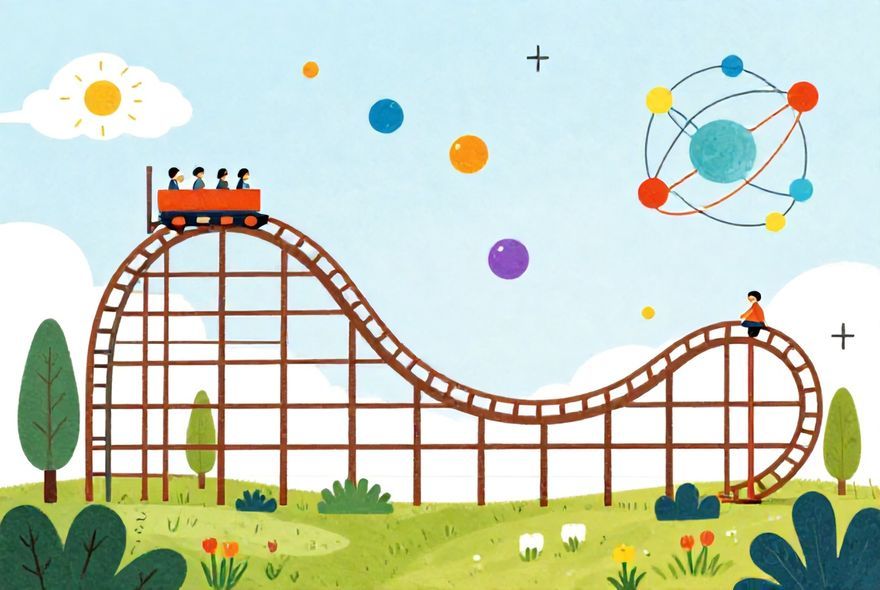
Ever tried explaining quantum entanglement to a six-year-old, only to end up entangled yourself? Fear not! In our Guide To Explaining Complex Physics Concepts To Kids, we’ll show you how to master the art of breaking down mind-bending physics into digestible analogies that captivate young minds. Forget the dreary lectures; we’re diving into a world where gravity is like a cosmic glue stick! Drawing insights from experts, this guide will ensure your explanations are engaging and scientifically sound. Ready to inspire some mini-Einsteins? Let’s dive in and make physics fun!

Key Takeaways
- Discover why kids can grasp the multiverse with a sprinkle of wonder.
- Unlock the secrets to keeping curious minds engaged without oversimplifying physics.
- Use fun analogies that make complex science as tasty as their favorite ice cream.
- Learn to transform baffling theories into brain-tickling tales for children.
- Foster epic ‘aha’ moments in kids by simplifying, not diluting, physics concepts.
Why Physics Matters to Your Kids (And Why They Actually Care)
Look, I get it. Physics sounds intimidating, right? All those equations, quantum mechanics, and relativity stuff that makes your head spin. But here’s the thing—kids are naturally curious about how the world works. They’re constantly asking “why?” and “how?” and frankly, that’s the spirit of physics. The trick to explaining complex physics concepts to kids isn’t about dumbing things down; it’s about translating mind-bending ideas into stories and analogies they can actually visualize. When you master the art of breaking down these concepts, you’re not just teaching science—you’re igniting a passion that might shape their entire future.
- Kids Think in Stories, Not Equations: Children grasp concepts through narratives and comparisons way better than abstract formulas. Physics becomes memorable when it’s tied to something they experience daily—like why ice cream melts or how their favorite video game character jumps.
- Curiosity is Your Superpower: Kids ask the best questions naturally. Instead of shutting them down with “that’s too complicated,” lean into their curiosity and find creative ways to explore answers together without oversimplifying the science.
- Analogies Bridge the Gap: The most effective way to explain complex physics concepts to kids is through digestible analogies. A bowling ball on a stretched rubber sheet? That’s how gravity works. Simple, visual, accurate enough for young minds.
- Engagement Beats Perfection: You don’t need to be a physicist to talk about physics with your kids. What matters is keeping their minds engaged and showing them that science is cool, relevant, and everywhere around them.
The Power of Analogies: Your Secret Weapon
You know that moment when you try explaining something complex and your kid’s eyes glaze over? That’s your cue to switch to analogies. Analogies are like the cheat code for making physics accessible. They take abstract concepts and connect them to things kids already understand. The beauty of analogies is that they’re not just dumbing things down—they’re creating a bridge between what’s familiar and what’s mind-bending.
- Gravity Isn’t a Pull—It’s a Dip: Instead of saying gravity “pulls” things down, imagine space as a stretched rubber sheet. A bowling ball placed on it creates a dip, and smaller objects roll toward that dip. This analogy actually mirrors Einstein’s explanation without requiring calculus. Kids get it instantly because they’ve seen marbles roll.
- Atoms Are Like Solar Systems: Electrons orbiting a nucleus? Think of it like planets orbiting the sun. Sure, it’s not perfectly accurate (electrons don’t really orbit), but it gives kids a mental picture that’s close enough to start conversations about the incredibly tiny world we’re made of.
- Sound Travels in Waves—Like Ripples in Water: Drop a pebble in a pond and watch the ripples spread. That’s exactly how sound moves through the air. Kids can see, touch, and understand this analogy immediately, making sound waves feel less abstract and more tangible.
- Electricity Flows Like Water Through Pipes: Current, resistance, voltage—these become way less intimidating when you compare them to water flowing through pipes. More pressure (voltage) = faster flow. A narrow pipe (resistance) = slower flow. Boom. Suddenly circuits make sense.
- Light Bends Like a Pencil in Water: Show your kid a pencil in a glass of water. It looks broken, right? That’s refraction. Light bends the same way when it moves between different materials. They can literally see the physics happening in real time.
Making It Real: Physics in Everyday Life
Here’s what I’ve learned—kids engage way more when they see physics isn’t some distant, theoretical thing happening in labs. It’s happening right now, in their lives, every single second. When you connect complex physics concepts to kids’ daily experiences, everything clicks. Suddenly, physics isn’t boring textbook material; it’s the reason their skateboard slides, why they float in the pool, and how their favorite apps work.
- Kitchen Physics is the Best Physics: Cooking is basically applied physics. Why does salt make ice cream freeze? (Freezing point depression.) Why does bread rise? (Gas expansion.) Why does oil float on water? (Density.) Turn your kitchen into a physics lab and kids won’t even realize they’re learning about molecular behavior and thermodynamics.
- Sports Reveal Newton’s Laws in Action: Every sport is physics. A basketball’s arc follows projectile motion. A soccer ball’s curve is Magnus effect. When kids understand that Newton’s laws explain why they can’t stop a moving bike instantly, physics becomes the ultimate performance hack. They’re not just playing—they’re executing physics principles.
- Technology They Love is Applied Physics: Smartphones, video games, drones—all physics. Explain how a touchscreen works (capacitive sensing), why games need faster processors (processing physics calculations), or how drones balance (gyroscopic stability). Suddenly, their favorite tech gadgets are physics demonstrations.
- Weather and Space Tie Into Everything: Why do we have seasons? (Earth’s tilt and revolution.) Why is the sky blue? (Rayleigh scattering.) Why do stars twinkle? (Atmospheric distortion.) These questions kids naturally ask have amazing physics answers that connect to what they see every day.
- Music is Vibrating Physics: Play a guitar string and explain that the sound they hear is created by vibrations traveling through air. Different vibration speeds create different pitches. Suddenly, music theory and physics merge, and kids understand why a thicker string sounds deeper—it vibrates more slowly.
Breaking Down the Big Concepts Without Oversimplifying
This is where the real skill comes in. You want to keep concepts digestible without stripping away the actual science. The challenge is finding that sweet spot—explaining complex physics concepts to kids in ways they understand while maintaining scientific accuracy. It’s like seasoning food: too little and it’s bland, too much and it’s inedible. You need the right balance.
- Start with the Observation, Then Add the Science: Kids notice things. A shadow changes length throughout the day. Water goes from ice to liquid to steam. Start there. Then layer in the physics. The shadow changes because Earth rotates and the sun’s angle shifts. Water changes states because heat energy affects molecular movement. Build from what they see to what’s actually happening.
- Use Progressive Complexity: You don’t explain quantum superposition to a five-year-old the same way you’d explain it to a ten-year-old. Start simple (a particle can be here or there), then gradually add nuance (it’s actually both until measured). This approach keeps them engaged at every age without feeling condescended to as they grow.
- Acknowledge What We Don’t Know: Physics is incredible because it’s honest about mysteries. Say things like “Scientists aren’t completely sure why this happens yet, but here’s what we think…” This teaches kids that science is a process of discovery, not just memorized facts. It’s way more engaging than pretending we have all the answers.
- Use Thought Experiments, Not Just Demonstrations: Schrödinger’s cat is famous for a reason. Ask kids “What if we put a cat in a box with a quantum event?” Sure, it sounds weird, but it makes them think deeply about observation and reality. Thought experiments make abstract physics tangible in the imagination.
- Introduce Variables Gradually: Don’t throw formulas at kids. But do show them that physics involves relationships. “Faster objects need more force to stop” is the essence of F=ma without the math. As they mature, you can add the mathematical layer without it feeling like a shock.
Interactive Experiments That Stick With Kids
You know what’s way more powerful than telling a kid about physics? Letting them experience it. Interactive experiments are where the magic happens. When kids do experiments themselves—even simple ones—the concepts cement in their brains. They move from passive listeners to active explorers. Plus, experiments are fun. Who doesn’t love getting hands-on and discovering how things actually work?
- The Spinning Bucket Experiment (Centripetal Force): Fill a bucket with water and spin it fast. The water doesn’t spill because centripetal force keeps it pressed outward against the bucket. Your kid will be amazed. This demonstrates that gravity isn’t always “down”—it’s toward the center of circular motion. They’ll never forget it because they felt the force.
- Bending Light with Refraction: Fill a glass with water, place a coin at the bottom, and step back until you can’t see it. Now pour water around the coin—suddenly it’s visible. Light bends at the water-air boundary. Kids see it happening right before their eyes, making refraction concrete instead of abstract.
- Static Electricity with Balloons: Rub a balloon on hair, stick it to a wall. Boom. Static electricity demonstrated. Then show how it can bend a stream of water from a faucet. Kids realize invisible forces are real and powerful. This opens doors to understanding electromagnetic forces without needing heavy theory.
- Density Columns with Liquids: Layer honey, dish soap, water, and oil in a glass. They don’t mix because of different densities. Drop different objects and watch them sink to their density level. It’s colorful, visual, and demonstrates molecular behavior in a way kids absolutely get.
- Making Waves with Rope and Springs: Tie a rope to a door and create waves by shaking your end. Show how waves travel, reflect, and interfere. Then grab a Slinky and do it again. Kids see that waves are universal—they work the same whether it’s water, sound, or light. This unifies understanding across different physics domains.
Talking About Mind-Bending Concepts: From Relativity to Multiverse
Okay, so here’s where it gets really interesting. Your kid asks about time travel, alternate realities, or whether nothing is real. These are the conversations that make explaining complex physics concepts to kids feel like you’re in the deep end. But you know what? These are also the most exciting conversations. Einstein’s relativity, quantum mechanics, and the possibility of a multiverse are genuinely mind-bending. The key is meeting kids where they are—curious and imaginative—while gently introducing actual physics.
- Relativity Isn’t About Speed; It’s About Perspective: Imagine you’re on a train throwing a ball forward. To you, the ball moves at, say, 10 mph. But to someone standing outside the train, the ball moves at the train’s speed plus 10 mph. That’s relativity in a nutshell—motion looks different depending on your reference frame. Einstein took this concept and showed it applies to light and time too. Time moves differently depending on how fast you’re moving. It sounds crazy, but it’s real and measurable.
- Quantum Weirdness: Particles Act Differently When Watched: Here’s something genuinely strange that’s actually true. At the quantum level, particles behave differently when observed versus when they’re not. It’s not that we’re just gathering information—the act of observation literally affects reality. Kids find this both creepy and fascinating. It challenges their intuition about how reality works, which is exactly what makes it a great teaching moment.
- The Multiverse Concept Isn’t Science Fiction: Many physicists seriously consider that our universe might be one of many. Different branches might have different physical laws. Some versions of you might exist in parallel universes making different choices. For an accessible deep-dive into how to discuss this with kids, check out resources that break down multiverse theories in family-friendly ways. It sounds like fantasy, but it’s grounded in legitimate physics theory and quantum mechanics interpretations.
- Uncertainty is Fundamental, Not a Flaw: Heisenberg’s uncertainty principle states that you can’t know both a particle’s position and momentum with perfect precision. This isn’t because we lack tools—it’s because of how reality works at quantum scales. Kids grasp this better when you frame it as: “The universe plays by different rules at tiny scales than at big scales.” It’s not mysterious; it’s just different physics.
- Black Holes are Physics Pushed to Extremes: Gravity so strong that light can’t escape? That’s a black hole. It’s not magic—it’s what happens when you compress a massive object into an incredibly small space. Kids love black holes because they’re visually dramatic and genuinely extreme. Use them as gateways to discuss gravity, spacetime curvature, and the limits of our understanding.
Tools and Resources That Make Teaching Easier
Let’s be real—you don’t need a PhD to explain complex physics concepts to kids effectively. What you do need are good tools and resources. The internet is packed with incredible videos, simulations, and interactive tools designed specifically to make physics accessible. The best part? Many of them are free. Having the right resources in your toolkit makes teaching way easier and keeps kids engaged for longer.
- Interactive Simulations Show Physics in Real-Time: Online physics simulations let kids manipulate variables and see instant results. Change gravity strength and watch how planets orbit differently. Adjust wavelength and see how color changes. These aren’t just cool—they make abstract concepts concrete by showing cause-and-effect relationships kids can control.
- YouTube Channels Dedicated to Physics for Kids: There are amazing channels specifically designed to explain complex physics concepts to kids using demonstrations, animations, and clear language. Visual storytelling is powerful. A ten-minute video can make concepts click in ways that paragraphs of explanation never could.
- Books That Explain Physics Through Stories: Children’s books about physics don’t have to be dumbed down. Many excellent books use narrative and illustrations to explore real physics concepts. They work great for reading together and sparking conversations about how the world works.
- DIY Experiment Kits and Materials: You don’t need expensive lab equipment. Most powerful physics experiments use stuff you already have at home. Balloons, water, string, mirrors, magnets, and household liquids can demonstrate incredibly complex principles. The “DIY” approach also teaches resourcefulness.
- Science Museums and Planetariums: Nothing beats hands-on experience in a space designed for learning. Museums have interactive exhibits where kids can experience physics directly. Planetariums show you the scale of the universe in ways that make concepts like gravity and light-years feel real.
Common Mistakes Parents Make When Teaching Physics
I want to be honest—there are some pitfalls when explaining complex physics concepts to kids. I’ve made them, you’ve probably made them, and they’re totally fixable. The most common mistakes usually come from good intentions but miss the mark on engagement or accuracy. Knowing what to avoid helps you become a better physics explainer.
- Going Too Deep Too Fast: Kids ask “Why is the sky blue?” and some people launch into Rayleigh scattering and electromagnetic spectrum explanations. Start with a simple answer. “Light bounces off tiny air molecules, and blue light bounces more than other colors.” If they want more detail, they’ll ask. Meet them at their level.
- Using Analogies That Mislead: Some analogies are so simplified they become wrong. Saying electrons “orbit” a nucleus like planets around the sun? It’s a useful visual, but it’s not accurate. Electrons exist in probability clouds. Better to say “electrons are like clouds of energy around the nucleus” and acknowledge that the real picture is more complex.
- Assuming Interest Follows Explanation: Kids don’t care about your explanation if they don’t see why it matters. Skip the lengthy intro about why physics is important. Jump to something they care about. “Your favorite video game uses physics to make characters move realistically” is way more engaging than “Physics explains how the universe works.”
- Shutting Down Questions with “That’s Too Advanced”: Kids ask the best questions. When they ask something you don’t know, admit it. “That’s a great question! Scientists are still figuring that one out” is infinitely better than dismissing their curiosity. It shows that not knowing is okay and that science is ongoing.
- Forgetting That Wonder Matters More Than Accuracy (At First): Your goal with young kids isn’t perfect scientific accuracy—it’s igniting wonder. Help them love the questions and the process of discovery. As they mature, you can layer in more precise explanations without crushing their initial enthusiasm.
Fostering Lifelong Physics Curiosity
Here’s the thing about explaining complex physics concepts to kids—you’re not just teaching them about gravity or light. You’re teaching them how to think about the world. You’re showing them that curiosity is valuable, that asking “why?” is powerful, and that understanding how things work is genuinely cool. If you can spark that curiosity, they’ll keep asking questions forever. That’s the real win.
- Celebrate Questions More Than Right Answers: When your kid asks a great question, react like they just discovered something amazing. Because they did. A kid who asks “Why can’t we see air?” is engaging in genuine scientific thinking. Celebrate that. The specific answer matters less than the habit of questioning.
- Let Them Lead the Conversation: Follow their interests. If they’re obsessed with space, dive deep into gravity and orbits. If they love video games, explore the physics of movement and collision detection. Personalized learning sticks way better than a generic curriculum. Their passion is your guide.
- Admit When You Don’t Know: This is actually one of the most valuable things you can model. “I don’t know—let’s find out together” teaches them that learning is a lifelong process. It also shows that not knowing is not a failure; it’s the starting point for discovery.
- Connect Physics to Their Future Possibilities: Kids who love physics might become engineers, astronomers, game developers, or architects. Show them that understanding physics opens doors. “The physicist who figured out X went on to…” makes careers in science feel real and achievable.
- Keep Your Own Sense of Wonder Alive: Your enthusiasm is contagious. If you think physics is cool, they will too. Stay curious yourself. Read about new discoveries. Watch cool physics videos. Your genuine interest in how the world works is the most powerful teaching tool you have.

Understanding complex physics concepts like the multiverse can be child’s play with the right approach—and that’s precisely the mission of our Guide To Explaining Complex Physics Concepts To Kids. By using digestible analogies, you can master the art of breaking down these mind-bending topics without oversimplifying the science, keeping those curious minds fully engaged. Diving into this blog, we’ve explored practical ways to discuss intricate physics by connecting fantastical concepts to everyday experiences. It’s all about making the unbelievable believable through context kids understand, sparking imagination while staying rooted in factual clarity. From understanding the basics of space-time to the wonders of the multiverse, this guide helps turn overwhelming science into engaging stories, reinforcing how powerful an informed imagination can be.
Now that you’ve delved into the nitty-gritty of turning complex topics like the multiverse into family-friendly stories, why not put your newfound skills to the test? Head over to our social media pages—Facebook and Instagram—to share your experience or pick up some new tips. You’ll find a community that’s just as enthusiastic about untangling the universe’s mysteries. Plus, it’s a great way to make science talk more than just small talk at family dinners! Let’s keep unraveling the cosmos, one curious question at a time!





Leave a Reply