

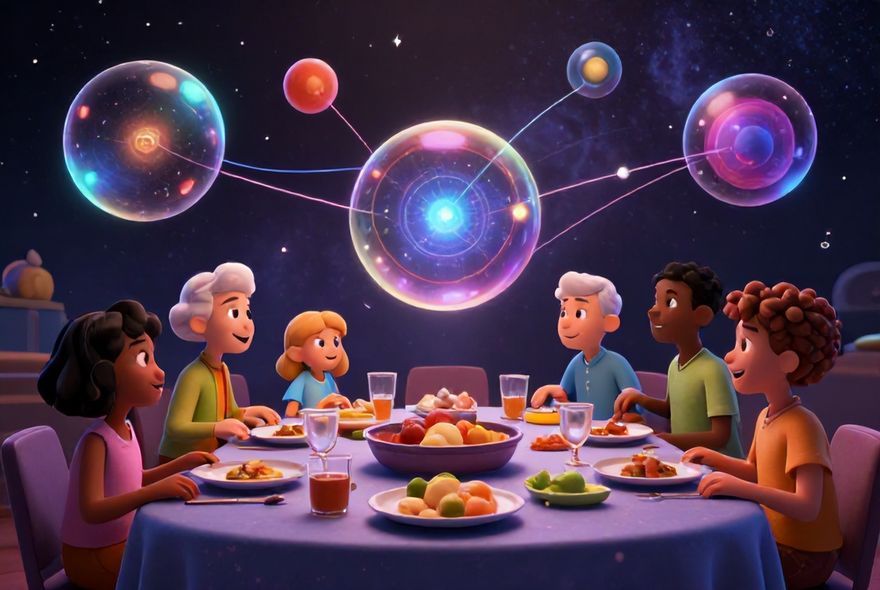
Ever found yourself floundering at the dinner table when the topic veers into the cosmic chaos known as the multiverse? In our blog, “How To Talk About The Multiverse With Your Entire Family,” we’re transforming those head-scratching moments into animated conversations. Whether you’re bridging the gap between Uncle Bob’s skepticism and your toddler’s endless ‘whys,’ we’ve got analogies that even Grandma can love. Inspired by insights from leading scientists, we promise: no black holes of confusion here. Let’s dive in and make those mealtime chats out of this world!
Key Takeaways
- Got curious toddlers or skeptical teens? Learn to explain the multiverse to all ages—even Uncle Bob!
- Discover fun, easily digestible analogies and examples for every family member.
- Turn dinner conversations into epic science chats with the ultimate multiverse guide.
- From dragons in parallel worlds to kid-friendly comparisons, we’ve got multiverse talk covered.
- Stop wondering how to tackle those ‘infinite universe’ questions—masterful explanations are here!
Why The Multiverse Fascinates Everyone (Even Your Uncle Who Only Watches Sports)
Look, let’s be honest—the multiverse is everywhere right now. It’s in the movies, it’s in the science podcasts, and it’s probably in that random conversation your teenager had at school yesterday. But here’s the thing: most people have no clue what it actually means, and that’s totally fine. The multiverse explained for families doesn’t have to be complicated or boring. It’s actually one of the coolest concepts you can chat about over dinner, and we’re going to show you exactly how to make it stick with everyone from your five-year-old to your skeptical teenager who thinks physics is a waste of time.
- The Multiverse Is More Accessible Than You Think: You don’t need a PhD to understand parallel universes. With the right analogies, your entire family can wrap their heads around the concept in minutes, not hours of confusing explanations.
- It Sparks Genuine Curiosity: Kids naturally wonder “what if,” and the multiverse is basically the ultimate “what if” question. Talking about alternate versions of themselves or different realities taps into that natural wonder that makes learning fun instead of like homework.
- Pop Culture Has Made It Cool Again: From Marvel movies to sci-fi shows, the multiverse is culturally relevant. Using these references helps bridge the gap between abstract science and things your family actually enjoys watching together.
- It Teaches Critical Thinking: Explaining the multiverse encourages your family to think beyond what they see, question reality in a fun way, and understand that science isn’t just about memorizing facts—it’s about exploring possibilities.
- Everyone Has An Opinion: The beauty of multiverse conversations is that there’s no one “right” answer yet. Your teenager’s wild theory about alternate dimensions is just as valid as any physicist’s take, which makes family discussions feel more like adventures than lectures.
Breaking It Down for the Little Ones: Toddler-Friendly Multiverse Explained
Okay, so you’ve got a four-year-old who just asked what the multiverse is because they saw a superhero movie. Don’t panic. You’re not going to explain quantum physics to a kid who still believes dinosaurs might be hiding in the backyard. Instead, you’re going to use something they already understand: their own imagination. The key to multiverse explained for families with young kids is keeping it simple, visual, and tied to their world.
- The “Different Choices” Angle: Ask your toddler what would happen if they chose to wear their blue shirt instead of their red shirt today. Then explain that in another universe, they actually did wear the blue shirt, and in another one, they wore stripes. This isn’t about science yet—it’s about helping them visualize the idea that different choices create different outcomes, which is the heartbeat of multiverse thinking.
- Use Their Favorite Stories: Talk about how in one universe, Elsa from Frozen maybe didn’t have magic powers, or in another one, she and Anna were best friends from the start. Kids love when you remix their favorite characters, and it makes the concept feel less abstract and more like a fun game of “what if.”
- The Mirror Analogy Works Wonders: Imagine looking in a mirror and seeing yourself, but in the mirror, you’re doing something different—maybe you’re dancing, or eating ice cream, or wearing a silly hat. That’s kind of like another universe where you’re doing that right now. It’s simple, visual, and doesn’t require them to understand anything beyond what they see.
- Keep It Playful, Not Scary: Don’t make it sound like there are evil versions of them plotting against our world. Young kids can get anxious easily, so frame it as fun and exciting, not creepy or threatening. The multiverse is like having infinite storybooks about infinite versions of the world—and that’s awesome, not scary.
- Let Them Ask Questions Without Judgment: When your three-year-old asks if there’s a universe where cookies are healthy, say yes and celebrate their creativity. You’re not teaching physics here; you’re encouraging imagination and showing them that questions about reality are cool and worth exploring.
Elementary School Age: Building Real Understanding With Fun Experiments
By the time kids hit elementary school, they’re ready for something a bit meatier. They understand cause and effect, they’re curious about how things work, and they’re starting to think about bigger concepts. This is where multiverse explained for families gets genuinely fun because you can use real-world examples and even simple experiments to show how different choices create different paths. You’re basically planting the seeds for scientific thinking while keeping it totally age-appropriate.
- The Branching Path Visualization: Draw a tree or a road on paper and show how one path splits into two, then four, then eight. Explain that every choice you make creates a branch where you made a different choice instead. In our universe, maybe you had cereal for breakfast, but in another branch, you had toast. Your kid can draw their own tree and fill in the branches with different choices they could have made today. It’s concrete, it’s visual, and it teaches the core concept without any confusing quantum mumbo-jumbo.
- The Coin Flip Experiment: Flip a coin and have your kid guess heads or tails. Whether they guess right or wrong, explain that in another universe, the opposite happened. Do this a few times and let them see how probability works—some outcomes happen, some don’t, but in the multiverse, all possibilities happen somewhere. This is actually touching on real quantum mechanics, but in a way that makes sense for their age.
- Movie and Book References They Know: Talk about how in the Harry Potter universe, there’s probably a version where Harry didn’t survive, or where Hermione became a Death Eater, or where Ron never became best friends with Harry. Kids at this age are reading and watching these stories, so connecting the multiverse concept to stories they love makes it stick way better than abstract explanations.
- The “Choose Your Own Adventure” Connection: If your elementary schooler has read those choose-your-own-adventure books, you’ve got the perfect teaching tool. Explain that the multiverse is like every possible path in those books happening at the same time in different universes. They already get the concept; you’re just expanding it to reality.
- Introduce the Word “Parallel”: Start using the word “parallel universe” and explain that “parallel” means running alongside something. So a parallel universe runs alongside ours, but on a different track. It’s a vocabulary booster that helps them sound smart when they talk about this stuff with their friends.
Middle School Minds: Adding Layers of Complexity and Real Science
Welcome to the phase where your kid is starting to think they know everything but actually has just enough knowledge to ask really good questions. Middle schoolers are developing abstract thinking skills, they’re interested in “real” science, and they’re starting to understand that the world is way more complicated than it seemed when they were younger. This is where multiverse explained for families can get genuinely sophisticated without losing the family-friendly angle. You’re building on what they learned younger and adding actual scientific concepts that make sense for their developing brains.
- Quantum Mechanics Without the Equations: By middle school, your kid is ready to hear about how particles can exist in multiple states at the same time until they’re observed. This is the actual scientific foundation for multiverse theory, and it’s wild enough that it’ll blow their mind without needing calculus to understand it. Explain Schrödinger’s cat without getting too heavy—the cat is both alive and dead until you open the box, and in the multiverse, maybe there’s a universe where you opened the box and found it alive, and another where it’s dead. They’re ready for this.
- Many-Worlds Interpretation Explained Simply: This is a real scientific theory, and it’s perfect for middle schoolers because it’s mind-bending but totally understandable. Every quantum event that has multiple possible outcomes actually happens in different branches of reality. So when you make a choice, all versions of that choice are happening somewhere. It sounds like science fiction, but it’s legitimate physics, and kids this age find it genuinely fascinating.
- The Infinite Universe Concept: Talk about how big the universe actually is—billions of galaxies, each with billions of stars. Then explain that if the universe is infinite, it might contain infinite versions of everything, including infinite versions of Earth and infinite versions of them. The scale alone blows middle schoolers’ minds, and it sets up the multiverse concept perfectly.
- Pop Culture Deep Dives: By now, your middle schooler might be into Marvel, Doctor Who, or other sci-fi that heavily features the multiverse. Use these as jumping-off points for real discussions. Which interpretation of the multiverse does the show use? Is it different from what actual physicists think? This turns entertainment into a teaching opportunity without feeling preachy.
- Challenge Them to Think Critically: Ask them questions like “If the multiverse exists, does that mean nothing matters because infinite versions of us are making every possible choice?” This encourages philosophical thinking and shows them that science isn’t just about facts—it’s about grappling with big ideas and their implications.
Teenagers: Philosophy, Debate, and Real Scientific Theories
Alright, now you’re dealing with someone who’s basically a miniature adult with opinions and the ability to argue back. Teenagers are the perfect audience for multiverse explained for families because they’re curious enough to care, smart enough to understand complex ideas, and contrary enough to challenge everything you say—which actually makes for the best conversations. At this age, you can talk about the actual science, the philosophical implications, and the real debates among physicists. You’re not dumbing it down; you’re meeting them at their level and treating them like the intelligent people they’re becoming.
- The Real Scientific Debate: Here’s the thing—physicists actually disagree about the multiverse. Some think it’s real, some think it’s unfalsifiable nonsense, and some think we just don’t have enough information yet. This is perfect for a teenager who loves a good argument. Explain the different theories: the Many-Worlds Interpretation, cosmic inflation theory, the string theory landscape, and parallel branes. Let them pick their favorite and defend it. You’re basically giving them a physics debate they can actually understand and participate in.
- The Philosophical Rabbit Holes: If there are infinite versions of you making infinite choices, does free will matter? If everything that can happen does happen somewhere, is probability meaningless? These are the kinds of questions that keep teenagers up at night, and they’re legitimate philosophical problems that real scientists think about. Your teenager will love exploring these, and it shows them that science and philosophy aren’t separate things—they’re deeply connected.
- String Theory and Extra Dimensions: Teenagers are ready to hear about string theory, which proposes that there are extra dimensions we can’t see, and that there might be multiple universes separated by these dimensions. It’s genuinely complex stuff, but presented right, they can grasp the core concepts. Talk about how string theory suggests there could be 10 or 11 dimensions, not just the four we experience (three spatial, one time). That alone is mind-bending for the right reasons.
- The Simulation Hypothesis: Some physicists and philosophers seriously consider the possibility that we’re living in a simulation. If we are, then all the universes in the simulation are real in a sense, and maybe outside the simulation, there are other simulations. Your teenager will either think this is the coolest thing ever or the most ridiculous idea they’ve heard, and either way, you’ve got a conversation that actually engages their brain. Plus, they’ve probably seen “The Matrix” or “Black Mirror,” so the concept isn’t totally foreign.
- Real Scientists They Can Follow: Point your teenager toward real physicists who talk about the multiverse in ways that are actually interesting—people who write books, do podcasts, or have YouTube channels explaining this stuff. Brian Greene, Neil deGrasse Tyson, and others make this content accessible, and your teenager might actually get excited about physics if they see it presented by people who are genuinely passionate about it.
Common Family Objections (And How to Handle Them Like a Pro)
Here’s the reality: not everyone in your family is going to be excited about multiverse talk right from the start. You might have that one relative who thinks it’s all nonsense, or a sibling who gets frustrated because they don’t understand it, or someone who just wants to eat their dinner without getting a physics lesson. That’s totally normal, and honestly, it’s where the real conversation skills come in. Multiverse explained for families isn’t just about science—it’s about knowing how to present ideas in a way that doesn’t make people defensive or bored. Let’s talk about the objections you’re likely to face and how to handle them with grace and humor.
- The “That’s Just Science Fiction” Defense: You’ll definitely hear this one. Someone will dismiss the whole thing because it sounds made up. Here’s your response: some of the smartest physicists in the world actually believe in versions of the multiverse. It might sound like science fiction, but it’s grounded in real mathematics and real physics. You don’t have to convince them it’s definitely true—just that it’s a legitimate scientific idea worth exploring. Sometimes that’s enough to get them curious instead of dismissive.
- The “This Gives Me a Headache” Reaction: Some people’s brains just don’t like abstract concepts, and that’s okay. If someone shuts down the conversation because it’s too mind-bendy, don’t push it. Instead, ask them what they do understand and build from there. Maybe they get the “different choices” angle but not the quantum mechanics part. That’s fine. You’re having a conversation, not running a physics class.
- The Skeptic Who Demands Proof: Your skeptical teenager or that uncle who loves to argue will ask, “If the multiverse exists, where’s the proof?” Honest answer: we don’t have direct proof yet. That’s actually what makes it interesting. Scientists are working on ways to detect evidence of the multiverse, but it’s really hard because we can’t actually go to other universes. Frame it as “this is what we’re trying to figure out,” not “this is definitely true.” It’s more intellectually honest and actually more interesting.
- The “This Is Blasphemy” Concern: Some families have religious concerns about multiverse talk. This is worth addressing respectfully. You can explain that many religious people and scientists see no conflict between faith and the multiverse. The multiverse is a scientific hypothesis about how physical reality works; it doesn’t necessarily say anything about spiritual or religious matters. They can coexist in someone’s worldview, and that’s valid.
- The “Who Cares?” Attitude: Not everyone is going to find this fascinating, and that’s genuinely okay. Some people just don’t care about theoretical physics, and they’re not worse for it. If someone’s not interested, don’t force it. But you might plant a seed—mention how it connects to their favorite movie or show, and sometimes that’s enough to get them interested enough to listen.
Using Pop Culture and Movies to Make It Stick
Here’s a secret weapon for talking about multiverse explained for families: your family probably already loves movies and shows that feature the multiverse. Marvel’s “Multiverse of Madness,” DC’s various multiverse crossovers, “Everything Everywhere All at Once,” “Rick and Morty,” “The Flash”—the list goes on. These aren’t just entertainment; they’re actually pretty decent ways to introduce and explore multiverse concepts with your family. The cool thing is that everyone’s already invested because they like the story, so you’re not asking them to care about abstract science—you’re just connecting it to something they already enjoy.
- Movie Night Becomes a Teaching Opportunity: Watch something with multiverse themes and pause occasionally to ask questions. “Why do you think they can see into the other universe?” or “What would you do if you met yourself from another dimension?” You’re turning entertainment into conversation without being annoying about it. The best part? Your family is engaged because the movie already has their attention.
- Compare Movie Versions to Real Science: Some shows get the multiverse concept pretty close to real theories; others go full fantasy. Talking about the difference is genuinely interesting. “In this show, they’re treating the multiverse like it’s easy to travel between—would that actually be possible?” This teaches critical thinking and shows that your family can evaluate information thoughtfully.
- Use Characters as Examples: If your family loves a certain character, use them in your explanations. “Remember how Spider-Man met those other Spider-Men from different universes? That’s kind of like the multiverse concept—different versions of the same person existing in different realities.” Suddenly it’s not abstract anymore; it’s about characters they care about.
- Talk About the Plot Holes: Sometimes movies get the multiverse wrong or make decisions that don’t quite make sense scientifically. Let your family point these out. “Wait, how would that actually work?” These questions are perfect for deeper conversations about what’s real science and what’s just cool story stuff.
- Create a Family Ranking of Multiverse Movies: Have your family rank which movies or shows handle the multiverse concept best or most interestingly. This turns it into a fun activity instead of a lecture, and you’re getting their opinions on different interpretations of the same concept—which is actually what scientists do when they debate theories.
Making Multiverse Conversations a Regular Thing
The best part about multiverse explained for families is that you don’t have to make it a one-time big deal. Some of the coolest conversations happen casually, when someone brings something up naturally. But you can also gently encourage more of these talks by making them a regular part of your family dynamic. We’re not talking about forcing a mandatory “multiverse discussion” every Sunday—that would be weird and your family would definitely resist. Instead, we’re talking about creating an environment where these kinds of big, weird, wonderful conversations feel normal and welcome.
- Bring It Up When It’s Relevant: When your kid mentions they wish they’d made a different choice, that’s a perfect opening for a multiverse comment. “You know, in another universe, you did choose differently, and maybe you’re happy with that choice there.” It’s light, it’s casual, and it plants the seed that thinking about parallel realities is just a normal part of how we can think about life.
- Create a “What If” Conversation Jar: Write down weird “what if” questions and pull one out at dinner occasionally. “What if gravity worked backward?” “What if animals could talk?” “What if you had been born in a different country?” This gets everyone thinking about alternate realities in a playful way, and it naturally leads to multiverse conversations without feeling forced.
- Share Cool Science Stuff You Find: When you come across an interesting article, video, or podcast about the multiverse, share it with your family. You don’t have to make a big thing of it—just mention it casually. “Hey, I found this cool thing about parallel universes, want to hear about it?” Some people will, some won’t, but you’re normalizing the conversation.
- Let It Be Silly Sometimes: The best family conversations about this stuff often happen when someone says something ridiculous. “What if in another universe, cats are the intelligent species and humans are pets?” Roll with it. Laugh. Let your family be creative and weird. That’s when the real magic happens—when people feel safe being curious without worrying about sounding dumb.
- Celebrate Their Questions and Theories: When your family member comes up with their own theory about the multiverse, treat it like the cool thing it is. “That’s actually a great point” or “I never thought about it that way” shows them that their thinking matters and that this is a conversation where everyone’s contribution is valued, not just the “right” answers.
The Big Takeaway: Why These Conversations Matter
At the end of the day, multiverse explained for families isn’t really about whether the multiverse is real or how many dimensions might exist or whether we’re living in a simulation. It’s about something bigger and more important: it’s about creating space in your family life for wonder, curiosity, and big thinking. It’s about showing your kids—no matter their age—that asking questions about reality is cool, that thinking about possibilities is valuable, and that their ideas matter. It’s about those conversations where someone says something that makes everyone go, “Whoa, I never thought about it that way.” Those moments stick with people. They’re the ones that inspire kids to care about science, to keep asking questions, and to believe that the world is way more interesting than it seems on the surface. Plus, honestly, families that can talk about weird stuff together tend to have better communication about everything else too. You’re basically building conversation skills while talking about the multiverse, which is a pretty great two-for-one deal.
- It Encourages Lifelong Learning: When you show your family that learning doesn’t stop after school, that real adults are genuinely curious about how the world works, and that it’s fun to explore big ideas together, you’re setting them up to be curious people their whole lives. That’s a gift that keeps giving.
- It Bridges Age Gaps: Here’s something cool: you can talk about the multiverse in a way that works for your toddler, your elementary schooler, your teenager, and your parents all at the same table. Everyone’s learning something appropriate for their level, but you’re all in the same conversation. That’s rare and genuinely special.
- It Makes Science Feel Accessible: So many kids think science is boring or that they’re “not science people.” But talking about the multiverse in a casual, judgment-free way shows them that science is actually about imagination, asking good questions, and thinking creatively. It’s not just memorizing facts; it’s exploring possibilities.
- It’s Just Plain Fun: Sometimes the best reason to do something is because it’s fun. Thinking about alternate versions of yourself, talking about parallel universes, debating whether we’re in a simulation—it’s genuinely entertaining. Your family will enjoy these conversations, and that’s reason enough to have them.

As we wrap up our journey through the multiverse, you’re now equipped with engaging conversation starters that can tickle the imagination of everyone around your dinner table. From offering simple analogies like stacking different sheets of paper to describe parallel universes for toddlers to diving into the theoretical nuances of physics for those skeptical teenagers, you can transform dry scientific dialogue into an enriching family affair. The magic here lies in tailoring the complexity of the multiverse discussion to suit each family member’s curiosity, making even the most skeptical teenager interested in exploring the vast possibilities of our universe(s). This is how you make those dinner table conversations truly memorable while helping your family appreciate the wonder of science and endless possibilities.
So, what do you think? Ready to bring up the multiverse at your next family feast and see where the conversation takes you? Whether you’re revamping dinner chats or just out to expand horizons, let’s make these discussions as endless as the multiverse itself. Share your experiences and any newfound insights on our Facebook, snap a photo of your family debates for Instagram, or retweet us on Twitter. Let’s keep this universe-spanning chat going beyond the dinner table!





Leave a Reply